
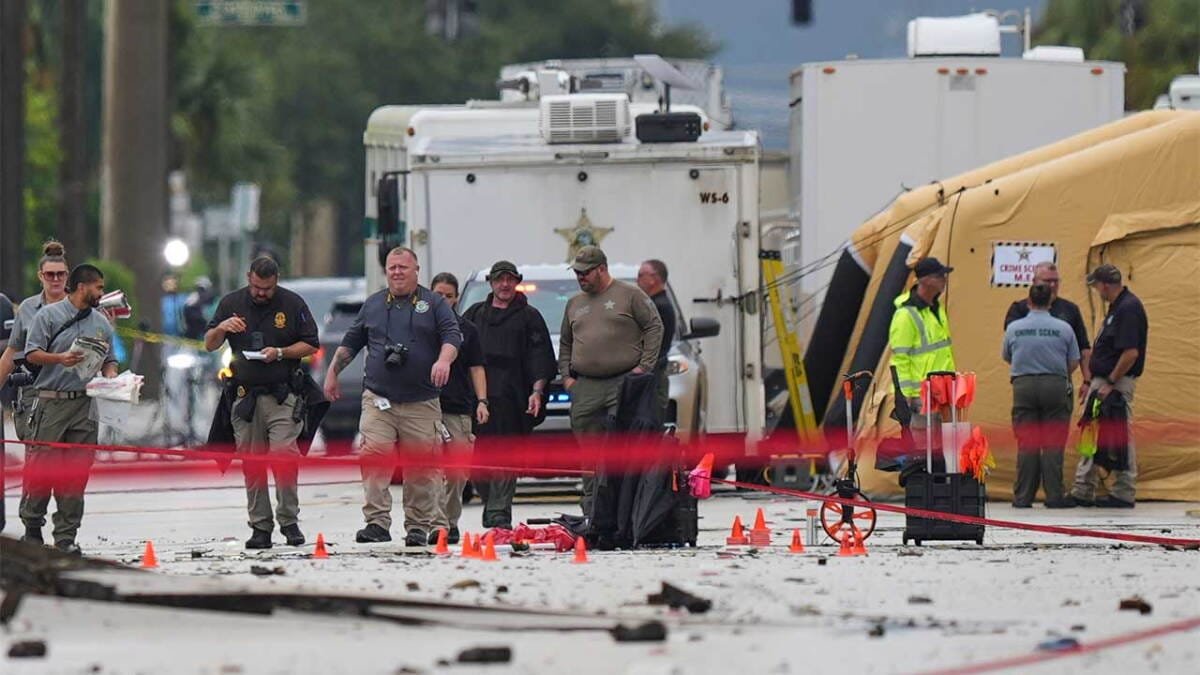
The National Transportation Safety Board (NTSB) confirmed on November 3 that important components of a Learjet 60’s tail separated from the aircraft before it crashed in Palm Beach County, Florida, on November 1, killing all nine people aboard.
During its second briefing, NTSB board member Tom Chapman revealed that the aircraft’s left elevator, a critical flight-control surface used to control the aircraft’s nose, was found broken into three pieces. The fragments were recovered between approximately 1.3 and 3.8 miles from the crash site, indicating that the components separated before impact.
Chapman explained that losing the elevator would have significantly affected the pilots’ ability to control the aircraft’s pitch and recover from its steep descent. However, he cautioned that the extreme speeds involved may have made the control surface ineffective even if it had remained attached.
Before the accident, the crew reported light clear ice accumulation, moderate turbulence and altitude deviations of around 700 feet while cruising at 35,000 feet. They later reported precipitation and requested clearance to climb to 37,000 feet.
Less than 30 seconds after receiving clearance, the crew reported that the aircraft was descending. They subsequently declared an emergency and reported an overspeed condition, with one radio transmission describing a descent rate of approximately 20,000 feet per minute.
Investigators have not yet established whether aerodynamic forces during the rapid descent caused the tail components to separate or whether the separation itself contributed to the loss of control. Weather conditions remain a major focus of the investigation.
The NTSB expects to release a preliminary report in approximately one month, while determining the probable cause of the crash could take more than a year.
